The problem
A new chair, clerk or governance lead inherits a board and has no honest way to see where governance actually stands before changing anything. Evidence of good practice lives in minutes, emails and people's heads.
What I built
A self-assessment built on the SGAF framework. The board works through each element by stage or by governance function. Every element has a question, Secure and Developing descriptors, and a card saying where to find the evidence: on the school website or in local governance files. The board picks a status and the answer saves at once.
Evidence capture is built in. Anyone with access can add a page link, a document reference or a short note against an element, and each entry is timestamped, so the board can see how its picture built up over the year. Several people can work on the same school across several sessions, and the work can stop and resume at any point.
Design decisions
The board sets every status. Visit reports, audits and evidence entries help it decide, but no tool sets a status for it. That keeps the self-assessment a judgement rather than a calculation that drifts out of the board's hands.
What you can see
A live dashboard with progress and Secure, Developing and Not Started counts, filters by stage and section, a Next incomplete button that walks the board through, and a printable report with every element, its status and its recorded evidence.
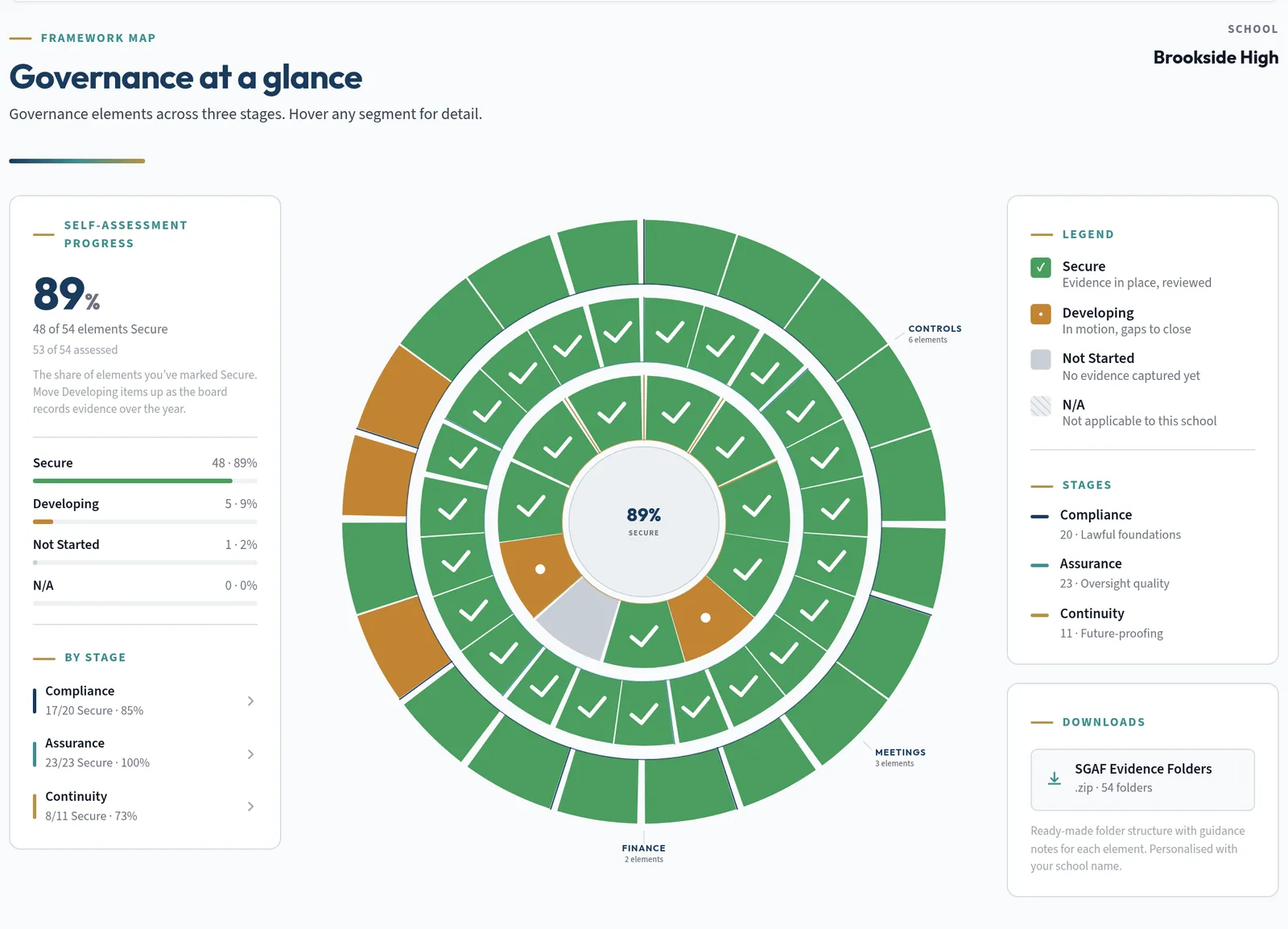 (opens the full-size screenshot in a new tab)
The result
The spine of the product. Visits and audits feed it, the Board Intelligence Report reads it as the board's internal view, and Trust Oversight rolls it up across every school. Where an element is Developing, it points to the next step: an item for a meeting or data from the headteacher.