The problem
Governor visits are often informal: someone drops in, writes a few notes, and the evidence stays in their notebook. Boards cannot show that each priority was looked at properly across the year, and statutory monitoring roles drift from one year to the next.
What I built
Two connected apps on one engine.
Progress Visits takes the school improvement plan as a PDF or Word document. AI extracts the priorities, an operator reviews the extraction, and only then is the plan released to the school, so nobody works from half-extracted lines. Each priority gets a named governor and up to three visits across the year, and a Year at a Glance heatmap shows the state of every visit on one page.
Compliance Visits does the same for the board's statutory monitoring roles, from Attendance and Safeguarding to SEND, Pupil Premium, Finance and Wellbeing. The board ticks the roles it holds and names a governor for each, and every pack carries plain-language statutory references with the legal citation in brackets.
Design decisions
Visit packs are generated as Word documents with the priority or role, the term's focus and the challenge questions. After a visit, the governor writes the report through a private link with no login, saving as they go. Named reviewers approve it or request changes, and only an approved report becomes a published, board-visible record. Marking a visit complete is recorded separately, because a visit happening is not the same as evidence of what it found.
What you can see
The Governor Assurance Plan: one document covering every priority and role, the named governor against each and the visit pattern across the year, with term bundles that send a whole term's packs in one email.
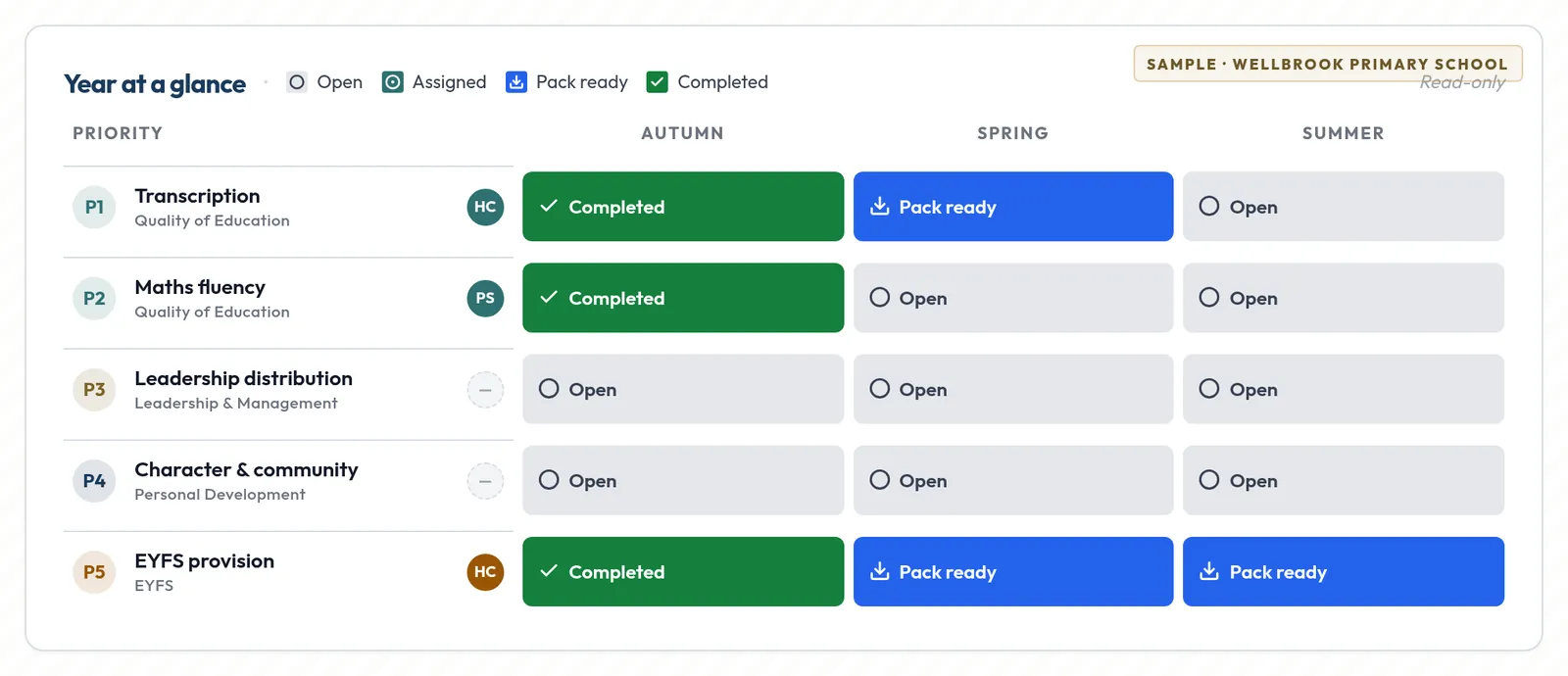 (opens the full-size screenshot in a new tab)
The result
A year of monitoring planned before the first full board meeting, with every visit producing a record the board can stand behind. It is the assurance model running as software.