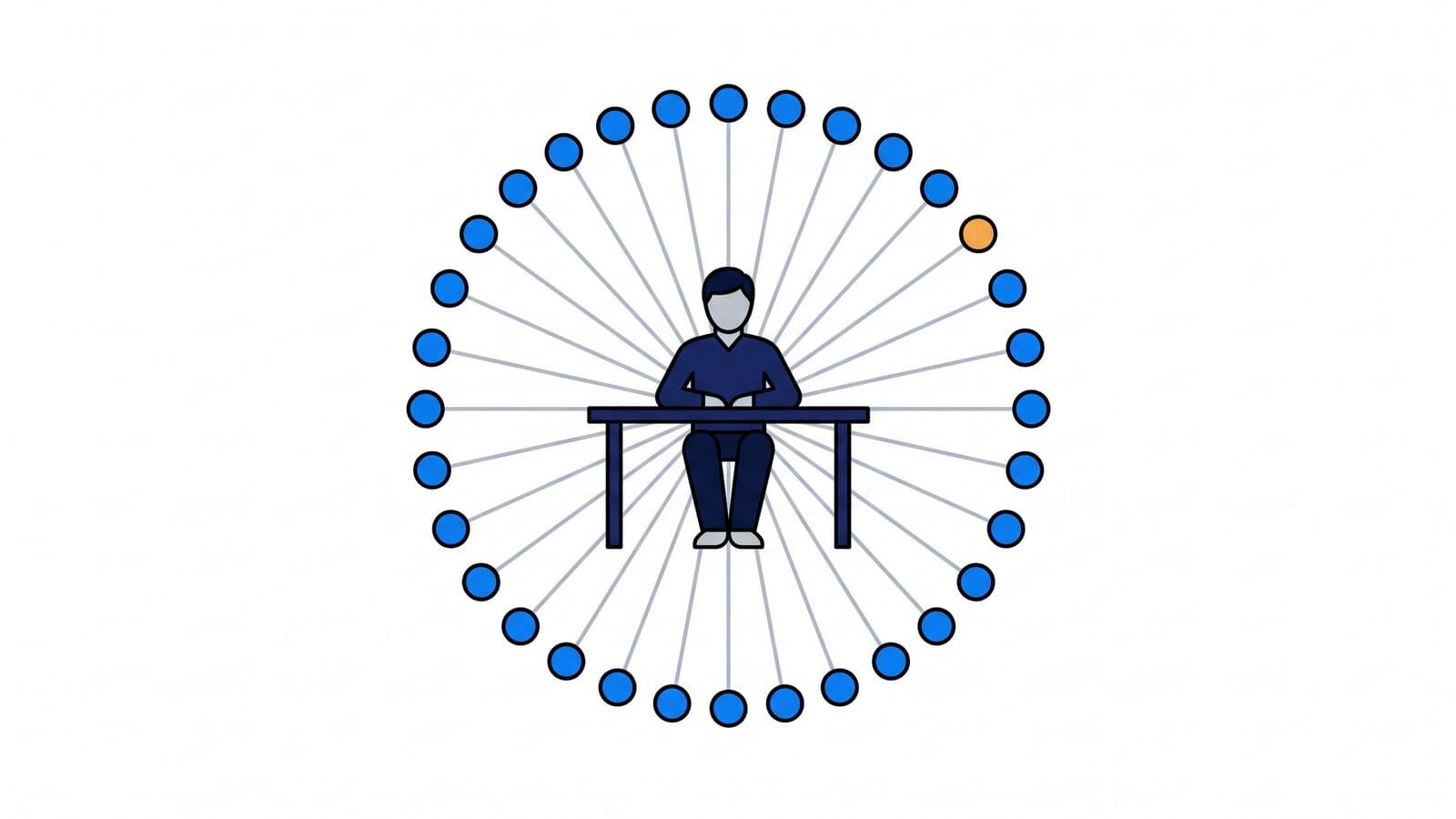
Edtech sells headcount. Look at any established supplier to schools and you will find a sales team, a customer success team, marketing, support, product, engineering and finance. Each one is a department with a manager, a tool stack and a meeting rhythm. Schools pay for all of it in the licence fee.
I run SGAF, a governance assurance product for UK schools and academy trusts, on my own. I do it alongside a full-time job and a family. The thing that makes that possible is not a trick. It is a team of AI agents with one job each, and a rule that I keep every decision that matters.
This post is the overview. The rest of this site is the detail.
Three principles
One front door. I talk to one agent. It works out who should handle a request, chases follow-ups, and brings back only what needs me. I do not open a dozen tools. I send a message and it comes back as tasks.
Specialists behind it. Each agent has exactly one job, written down, plus a list of anti-jobs it must not do. A research agent researches. An outreach agent drafts. A content agent writes. None of them try to do everything, and the ones that drifted into doing everything got retired.
Humans keep the decision rights. Agents prepare, draft, check and remind. I decide, send, spend and delete. Every outbound email is a draft that I send myself. A previous approval does not count. A standing rule does not count. If it leaves the building, I pressed the button.
It works like a small, slightly over-eager staff that never sleeps. I am still the one who signs things.
The pipeline, from radar to renewal
Here is how a lead goes from first spotted to supported customer, and which agent owns each step.
Radar. A scout runs a weekday morning sweep of sector news, funding, policy changes and trust growth. Each hit arrives with a source, a line on why it matters, and the agent that should own it next. Leads go to outreach. Content ideas go to content. Anything that touches the product goes to product.
Outreach. The outreach agent drafts a first-touch email that opens with something useful to the organisation, not a pitch. It never sends. I edit and send every one myself.
Meeting prep. Before every external call, an agent puts together a short brief: what the organisation says about itself, likely questions, and the one thing I want out of the meeting.
Debrief and coaching. After the call, a debrief agent asks me a few quick questions while it is still fresh. What was agreed, next steps, any objections. It turns that into next steps and scores the call against a simple rubric. Did I listen. Did I get a next step. Did I talk too much. Nothing is recorded; the agent works from my answers. Over time this is a sales coach that actually turns up.
Records. An agent keeps the commercial records consistent and catches errors, such as a deal value that does not match the price list.
Support. Product issues become tickets, and every reply to a customer comes from me.
Product. A product agent works to written, testable goals in a separate development environment. It proposes changes, checks previews, and runs user tests against a demo portal, writing them up as reports. It does not merge to production without me. A second agent sits outside that loop, writing tighter briefs and refusing to accept "done" without proof.
Content. A content agent owns the voice across the company page, my own replies and the site. A fact-check gate sits in front of it: any statistic needs a source, a date and a confidence score before it can be used. Posting happens only after I approve.
Data quality. SGAF leans on public education datasets. A freshness agent checks weekly whether each one is out of date and tells me only if something has slipped.
Finance. A ledger agent keeps the books reconciled and flags anything odd for me to look at. Neither it nor the tax agent moves money. They recommend.
Why this competes
Three reasons, and none of them is "AI is magic".
Cost structure. The departments above exist in my business as roles, not salaries. That changes what I can charge a school, and schools notice.
Speed without a rota. Work keeps moving on the days I am in meetings. Prep arrives before the call whether or not I remembered to do it.
Consistency. The house style, the banned phrases and what is off limits all live in one shared handbook. Every agent starts from the same rules. A new hire takes months to absorb that. An agent reads it on the way in.
What it does not do
It does not sit in a room with a governing board and understand why the board is nervous. It does not decide what the product should be. It does not know when a customer needs a phone call instead of an email. Those are mine, and the whole design exists to protect my time for them.
It is also not free. Around forty-five agents is too many, and I have written separately about the sprawl, the login friction and the results that never reached me. The system is a thing you run, not a thing you switch on.
The question for anyone small
If you run a small company against big ones, the question is not whether you can afford the staff. It is which decisions you refuse to delegate. Write that list first. Then build the team around it.
- agents
- operations
- edtech